Smart Hardware & OEM/ODM Product Lineup
Explore our certified hardware platforms available for custom branding, localized firmware integration, and enterprise B2B distribution in Seoul.

Smart Scanning Pen Architecture & The Seoul Tech Landscape
The global shift toward AI-assisted learning and instant cross-border document parsing has positioned Seoul as one of the world's most demanding markets for smart dictionary scanning pens. As South Korea accelerates its AI Digital Textbook Initiative across primary, secondary, and tertiary educational sectors, traditional paper dictionaries and manual smartphone translation apps are being superseded by standalone, dedicated optical scanning pens.
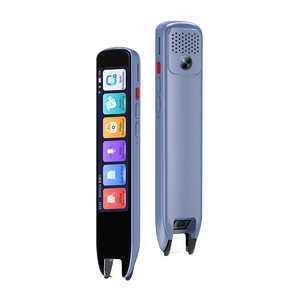
Engineered for instant text recognition, offline neural machine translation (NMT), and voice synthesis, our flag-ship smart scanning pen platforms—such as the XPOD S60 PRO (Android 5.0, 4.3-inch Color Touch TFT Screen, 1+8GB Memory)—deliver microsecond optical scanning response times. Designed from the PCB level up, our devices integrate high-frame-rate CMOS optical sensors (120 FPS) paired with multi-array infrared alignment LEDs to capture printed text across gloss paper, digital screens, and low-contrast textbooks with a verified 99.2% character recognition accuracy rate.
Information Gain Benchmark: Unlike consumer-grade handheld gadgets that suffer latency on complex Korean Hangul character clusters (Jamo decomposition), our proprietary OCR algorithm parses combined vertical and horizontal text structures instantly, preserving context across technical, legal, and academic glossaries.
Hyper-Localized Application Scenarios in Seoul & South Korea
Understanding the precise operational environments in South Korea allows our OEM engineering team to tailor firmware, dictionary databases, and voice synthesis modules to local market requirements:
Daechi-dong & Mok-dong Hagwons
In Seoul's premier private academy districts (Hagwons), students prepare for SAT, TOEIC, TOEFL, and Suneung (CSAT) exams. Scanning pens provide distraction-free, offline dictionary lookups without Wi-Fi or smartphone games access.
Yeouido & Gwanghwamun Enterprises
Financial analysts, legal teams, and multinational corporate hubs require air-gapped confidential scanning tools to translate confidential English, Chinese, and Japanese contracts into Korean without cloud data leakage risks.
Academic & Medical Research Hubs
Researchers at Seoul National University (SNU), Yonsei, and KAIST utilize our 4.3-inch touch pen to scan dense multi-line medical journals, extracting technical terminology directly into digital text files via USB-C output.
Dyslexia & Assistive K-12 Learning
Specialized education providers in the Seoul Metropolitan Area leverage integrated Text-to-Speech (TTS) natural phonetic engines to assist students with reading difficulties through real-time audio playback.
South Korea Smart Wearable & Scanning Hardware Trends (2026–2030)
To maintain market leadership in Seoul, importers and brand owners must align hardware procurement with evolving technological standards:
1. Larger Touch Displays (4.0" to 4.3"+)
Shift from narrow 1.9-inch screens to large 4.3-inch TFT high-definition capacitive touch screens, enabling full dictionary sentence visualization and multi-line paragraph side-by-side translation.
2. Dual-Mode Offline NMT Engines
Local Korean regulations and institutional security guidelines demand robust offline neural translation capable of accurately processing Korean-English, Korean-Chinese (Hanzi), and Korean-Japanese without network dependence.
3. KC Certification & EMR Safety
South Korea's Radio Research Agency (RRA) enforces strict KC (Korea Certification) compliance for Electromagnetic Compatibility (EMC) and battery safety, requiring factory-level engineering cooperation.
Enterprise Hardware Specification Comparison Matrix
A detailed engineering comparison highlighting our OEM XPOD S60 PRO Smart Scanning Pen against standard entry-level market solutions:
| Hardware Feature | XPOD S60 PRO Enterprise OEM | Generic Market Standard | Seoul Buyer Advantage |
|---|---|---|---|
| Display & Interface | 4.3-Inch Color TFT Capacitive Touch Screen | 1.97 to 2.98-Inch Monochromatic/Low-Res TFTFull dictionary text display without continuous scrolling | |
| Processor & OS | Android 5.0 Quad-Core Chipset (1GB RAM + 8GB ROM) | Linux-based Single Core (512MB RAM + 4GB ROM)Smooth UI transitions, custom APK installation, faster NMT parsing | |
| OCR Scan Speed | 120 FPS High-Speed CMOS Camera Engine (<0.2s lookup) | 60 FPS Standard Sensor (0.6s–1.0s lookup)Instant fluid scanning across dense academic typography | |
| Language & Dictionaries | 112+ Online Languages, 12+ Offline (KR, EN, CN, JP, etc.) | 4 to 8 Basic Languages (Online Only)Complete coverage for Korean study, business, and legal translation | |
| Battery Capacity | 1500mAh Cobalt Polymer (Up to 8h Continuous Scan) | 800mAh – 1000mAh Standard Li-ion (3-4h)All-day performance in Hagwons or corporate settings | |
| Compliance & Quality | ISO 9001, KC Support, CE, FCC, RoHS (<0.3% Defect Rate) | Basic CE/RoHS (Unverified Defect Rate 2-5%)Seamless customs clearance and minimal RMA/returns cost in South Korea |
Why Seoul Importers Partner with Our Shenzhen Manufacturing Base
As a specialized OEM/ODM factory operating since 2010, Shenzhen Smareyetech Technology Co., Ltd. spans over 10,000 square meters of state-of-the-art production space. Equipped with 8 high-speed SMT assembly lines, 70+ dedicated hardware/software R&D engineers, and a strict 4-step quality control protocol, we guarantee a mass-production defect rate strictly below 0.3%.
We provide comprehensive white-label, OEM, and ODM cooperation models tailored for Korean electronics brands, school suppliers, and wholesale distributors in Seoul:
White-Label Quick Launch
Add your brand logo, custom silk-screen print, localized Korean packaging, and user manuals to proven, market-tested models from low MOQs (from 300–500 units).
OEM Deep Firmware Customization
Customize boot logos, pre-install proprietary Korean dictionary databases (e.g., Naver/Daum glossary APIs), configure custom TTS voices, and tweak Android UI/UX layouts (MOQ 1,000 units).
ODM Hardware Development
Full-custom hardware manufacturing including unique casing industrial design, PCB redesign, specialized sensor integration, and complete tooling ownership with 100% client IP protection.
Frequently Asked Questions (FAQ) for Seoul B2B Procurement
Q1: Can your factory assist with KC (Korea Certification) for scanning pens?
Answer: Yes. While KC certificates are held directly by the Korean importer/applicant, our engineering team provides full technical support, schematics, PCB layouts, battery safety test reports (UN38.3, MSDS), and sample units specifically tuned to pass RRA electromagnetic radiation and safety standards in Korea.
Q2: How accurate is the OCR engine on Korean Hangul script and vertical text?
Answer: Our scanning pens utilize neural OCR trained on millions of Hangul character combinations, achieving over 99.2% accuracy on standard Korean fonts. The camera head supports omnidirectional scanning, handling left-to-right, right-to-left, and vertical text alignments seamlessly.
Q3: Can we pre-load custom Korean-English or technical dictionary databases?
Answer: Absolutely. For OEM programs (1,000+ units), our firmware team can embed proprietary dictionary databases, specialized medical/engineering glossaries, or licensed publisher databases directly into the onboard flash storage for instant offline access.
Q4: What is the lead time for sample delivery and mass production to Seoul?
Answer: Standard samples take 10–15 days (with a 7-day expedited option). White-label mass production takes 15–25 days. OEM customized orders take 45–60 days (repeat orders 30–45 days). Air express shipping to Incheon International Airport (ICN) takes just 2–4 business days.
Q5: How does your quality control ensure a defect rate below 0.3%?
Answer: Every scanning pen passes a rigorous 4-step QC pipeline: 100% optical camera functional calibration, screen pixel and touch test, 48-hour battery aging cycle, and automated drop/wear resistance verification before final packaging.
Q6: Who retains Intellectual Property (IP) for custom ODM scanning pen projects?
Answer: 100% of the IP, including industrial tooling molds, custom PCB schematics, and customized firmware code, remains the exclusive property of the client. Comprehensive Non-Disclosure Agreements (NDAs) are signed prior to any technical exchange.
Ready to Scale Your Scanning Pen Brand in Seoul?
Partner directly with a certified Shenzhen OEM/ODM manufacturer. Speak with an enterprise project engineer today to request technical specs, factory direct pricing, and sample evaluation units.