Commercial & Consumer Wireless Microphone Portfolio
Engineered for low latency, zero signal dropouts, and crystal-clear acoustic reproduction across international RF spectrums.
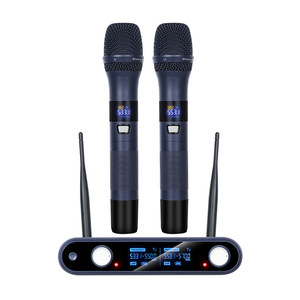
Professional UHF Karaoke Wireless Condenser Microphone System Auto Mute Handheld Mic with 120dB for Family Karaoke Performance
Ultra-clear condenser capsule with 120dB dynamic range, integrated accelerometer auto-mute, and phase-locked loop (PLL) synthesizer.
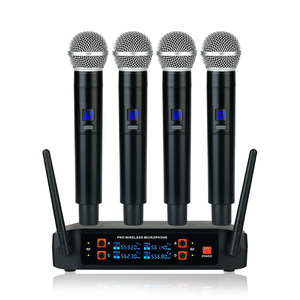
Wireless Microphone for Home Karaoke Conference & Performance-One Drag Four Model with 100Hz-20kHz Frequency Response 20km Range
High-density 1-drag-4 receiver architecture supporting multi-channel synchronization, anti-interference filtering, and wide frequency response.
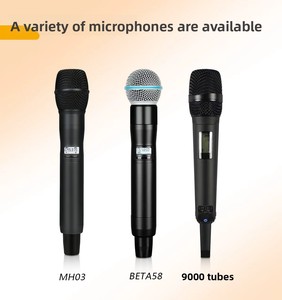
Factory Bulk Supply Hot Selling Profession Customization Supported Handheld Wireless Karaoke Microphone
Tailor-made B2B OEM design supporting custom branding, zinc alloy casing finish, DSP vocal curve tuning, and specialized gift packaging.
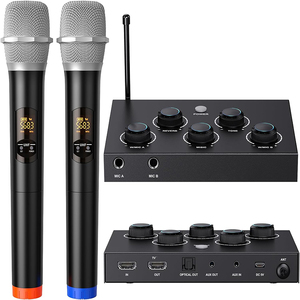
Wireless Microphone System PA UHF 16-Channel Handheld Mics BT Music Streaming Karaoke Style Noise Cancelling Crystal Sound Mixer
16 selectable channel system featuring Bluetooth audio streaming, real-time noise-cancelling DSP mixer, and cardioid pick-up pattern.
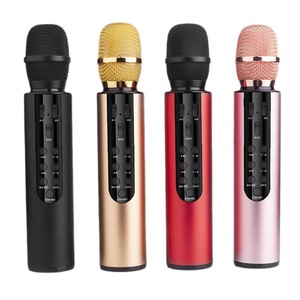
Karaoke Microphone 4 in 1 Wireless Microphone Handheld Portable Karaoke Machine, Home KTV Player Fot Android & IOS Devices
Versatile consumer design combining Bluetooth speaker, vocal processor, voice changer, and wireless microphone for Android and iOS systems.
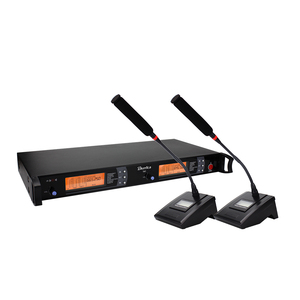
High Quality Factory Karaoke UHF Wireless Microphone
Commercial grade handheld microphone engineered for high SPL environments, featuring low THD (<0.5%), metal mesh grille, and shock protection.
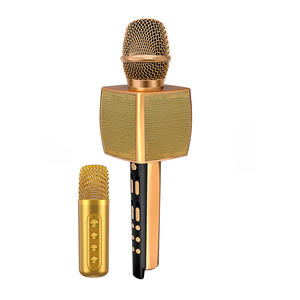
YS98 Family KTV Stereo Dual Wireless Mic Big Watts Sound 10W Karaoke Microphone
Dual microphone bundle with integrated 10W stereo speaker unit, acoustic reverb echo control, and duet pairing technology for home KTV.
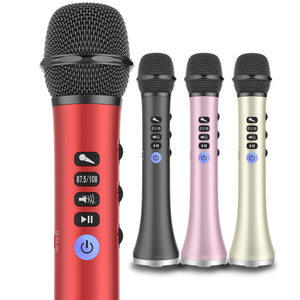
Dewant L-698 15W Powerful Handheld Mini Blue Tooth Karaoke Wireless Microphones With Speaker
High-power 15W acoustic output with full-range dynamic speaker, multi-level noise reduction algorithm, and continuous 8-hour battery playback.
Industry & Acoustic Technology Development Trends
Navigating the technological shift in wireless audio transmission, digital signal processing, and international frequency compliance.
The global wireless karaoke microphone manufacturing landscape is undergoing a profound technological shift. Driven by growing consumer demand for studio-grade vocal reproduction, low-latency performance, and seamless cross-platform digital ecosystem integration, hardware manufacturers are moving beyond basic analog FM designs. As a premier global exporter, understanding these technical macro-trends is vital for B2B procurement teams, brand distributors, and audio hardware importers.
1. Multi-Core DSP Noise Suppression & AI Voice Isolation
Legacy microphone architectures relied on passive analog RC filters that frequently clipped high dynamics or failed to isolate ambient room noise. Modern wireless karaoke systems integrate dedicated 24-bit/48kHz audio DSP chipsets. Advanced algorithms—such as real-time acoustic echo cancellation (AEC), automatic gain control (AGC), and neural-network background noise suppression—deliver pristine voice reproduction even in acoustically unrefined home environments.
2. Ultra-Low Latency & Bluetooth 5.4 LE Audio (LC3 Codec)
Audio latency has historically been the primary weakness of consumer Bluetooth microphones, where delays exceeding 40ms cause distracting echo loops for performers. Next-generation systems leverage Bluetooth 5.4 LE Audio alongside the Low Complexity Communication Codec (LC3). This technical advancement compresses transmission latency down to under 10ms while dramatically lowering power consumption, allowing multi-device broadcasting to home receivers without sync lag.
3. Dynamic Frequency Agility (UHF Phase-Locked Loop)
With wireless telecommunications networks encroaching on traditional broadcast bands (such as 700MHz/800MHz spectrum reallocation), commercial UHF microphone systems must deploy broad frequency agility. Modern PLL (Phase-Locked Loop) synthesized circuits feature automated frequency scanning. Handheld transmitters automatically pair with receivers over infrared (IR) or RF sync, switching away from congested channels within milliseconds to guarantee dropout-free performance.
Future B2B Procurement & Sourcing Trends
Key strategic shifts transforming international acoustic supply chain management, compliance criteria, and product customization.
Global buyers—ranging from regional electronics importers and Amazon FBA brand aggregators to commercial KTV system integrators—are fundamentally altering their supplier evaluation frameworks. Procurement decision-making has evolved beyond unit cost alone to embrace regulatory compliance, environmental sustainability, and modular manufacturing capabilities.
Regulatory RF Compliance & Regional Spectrum Pre-Certification
Customs seizures and radio frequency infringement penalties represent significant liabilities for importers. Tier-1 B2B buyers now mandate that exporters provide comprehensive pre-testing documentation across target market spectrums. This includes FCC Part 15 Subpart C certification for North America, CE RED (EN 300 422-1 / EN 301 489) compliance for the European Union, and TELEC registration for Japan.
Hybrid Commercial-Home Entertainment Convergence
The post-pandemic market has accelerated demand for dual-purpose audio hardware. Importers are increasingly prioritizing products that bridge the gap between heavy-duty commercial KTV lounges and home entertainment centers. Features like dual-singing duet synchronization, HDMI ARC/Optical receiver interfaces, and smart TV app compatibility have become standard requirements in global RFP specifications.
Eco-Design & High-Density Battery Safety Standards
Global environmental mandates—such as EU RoHS 2.0, REACH chemical regulations, and WEEE directives—require non-toxic zinc alloy casings, lead-free soldering, and recyclable packaging. Furthermore, integrated lithium-ion battery packs must strictly pass UN38.3, MSDS, and IEC 62133 safety standards to permit streamlined international air and sea freight logistics.
Enterprise Manufacturing Superiority & Quality Architecture
Combining world-class SMT automation, rigorous RF acoustic testing, and audited quality management systems.
As an industry-leading original equipment manufacturer (OEM) and original design manufacturer (ODM), our manufacturing infrastructure is built specifically to address the stringent quality demands of tier-1 global audio brands. Operating out of a state-of-the-art 10,000+ square meter facility equipped with automated SMT placement, ultrasonic shell welding, and fully shielded acoustic testing booths, we maintain total control over the entire production lifecycle.
4-Stage Quality Assurance Matrix
To ensure every shipped wireless microphone system meets strict performance tolerances, our factory enforces a mandatory 4-stage quality control workflow:
| Testing Phase | Inspection Parameters | Engineering Benchmark |
|---|---|---|
| 1. SMT & Component Screening | Automated Optical Inspection (AOI) of PCBA, IC soldering integrity, dynamic capsule frequency response matching. | 100% AOI coverage; zero cold-solder joint tolerance. |
| 2. Anechoic Chamber Acoustic Testing | Total Harmonic Distortion (THD), Signal-to-Noise Ratio (SNR), sensitivity curves (cardioid/omnidirectional), reverb attenuation. | THD < 0.5% @ 1kHz; SNR ≥ 105dB; 40Hz–18kHz frequency linearity verification. |
| 3. RF Spectrum & Environmental Stress | RF output power stability, spurious harmonic emission, 48-hour continuous battery burn-in, thermal chamber (-20°C to +60°C). | Zero carrier frequency drift; full compliance with FCC/CE emission masks. |
| 4. Final Mechanical & Drop Inspection | Metal mesh compression resistance, switch cycle endurance (>10,000 presses), 1.2m concrete drop testing, gift box drop test. | Zero structural or functional degradation post-test. |
Certified Compliance Framework
Our manufacturing plant operates under strict adherence to ISO 9001:2015 Quality Management Systems. Products exported to international partners carry self-owned factory certifications including CE (RED), FCC Part 15, RoHS, REACH, WEEE, CA Prop 65, and GCC. For clients requiring customized medical-grade or specialized commercial certifications, our dedicated regulatory compliance team facilitates full technical file preparation and lab testing support.
Frequently Asked Questions for B2B Procurement
Essential technical and commercial insights for audio equipment buyers, brand managers, and sourcing agents.
What is the difference between UHF, 2.4GHz, and Bluetooth wireless karaoke microphones?
What are your minimum order quantities (MOQ) for OEM and ODM projects?
How do you prevent acoustic feedback (howling) in high-power karaoke environments?
Can the factory customize wireless frequency bands to match our country's radio regulations?
What is your standard production lead time for sample development and bulk orders?
How does your factory achieve a defect rate of less than 0.3%?
What shipping terms and Amazon FBA logistics services do you support?
Who retains the intellectual property (IP) rights for customized ODM projects?
Partner with the Top Trusted Wireless Microphone Exporter
Accelerate your product roadmap with factory-direct pricing, certified RF engineering, and rapid turnaround. Speak with an acoustic hardware engineer today.