Smart Wearable OEM/ODM Manufacturer · Since 2010 · Shenzhen, China · Serving brands in 50+ countries
info@smareyetech.com
Smart Wearable Jewelry sits between personal style and practical technology. A ring may track sleep, while a pendant can send discreet alerts. Yet an elegant finish does not prove dependable performance. Buyers comparing Chinese suppliers need to look beyond polished product photos.
Computer scientist Mark Weiser wrote, “The most profound technologies are those that disappear. They weave themselves into the fabric of everyday life until they are indistinguishable from it.” His insight offers a useful lens: wearable jewelry should feel natural to use, not like a tiny gadget demanding constant attention. Small details matter. Check charging methods, app usability, material choices, battery life, and how clearly the supplier explains product testing. Ask for samples, technical documents, and direct answers about customization and production capacity.
This guide explores suppliers in China through those practical questions, rather than treating “top” as a universal ranking. A strong partner should communicate consistently, show relevant manufacturing experience, and explain how design changes affect cost and delivery. Request evidence, then compare it with the product in your hand. That is not enough. A sample can reveal comfort and finish, but it cannot guarantee every production batch will match. Supplier selection still involves judgment, and some details deserve a second look. The aim is to help readers assess options carefully and identify the questions worth asking before committing.
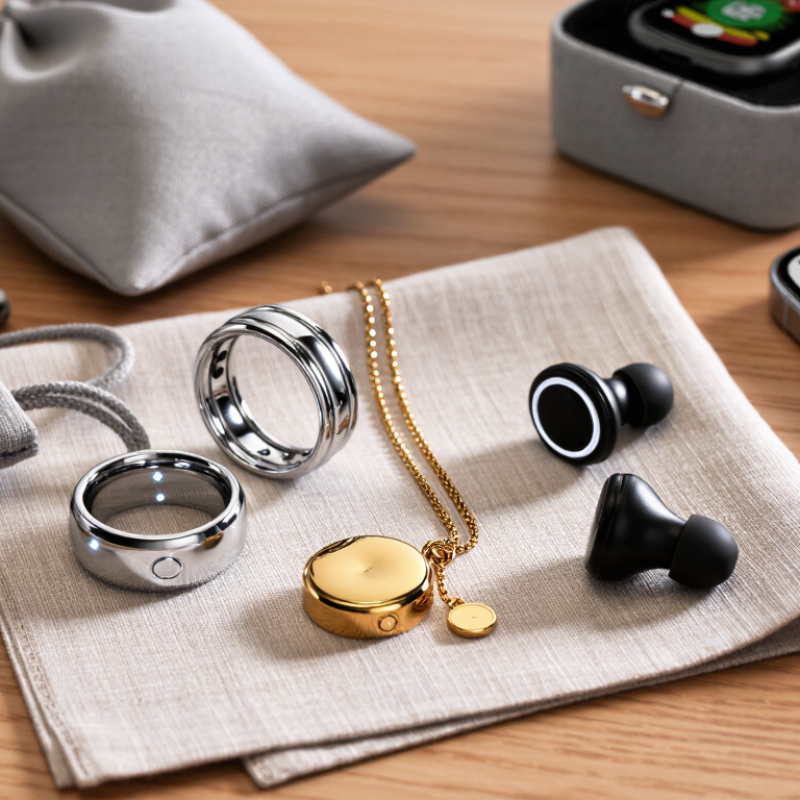
Smart wearable jewelry combines familiar accessories with compact electronics. A ring, bracelet, or pendant may contain sensors, a small processor, a battery, and a wireless connection. Depending on its design, it can track movement, recognize gestures, or send phone notifications. The electronics sit inside a small casing, often beneath a smooth metal or ceramic surface. The result is subtle. It is still a device, though, and needs charging and occasional software updates.
Sensors collect signals such as movement or changes in skin contact. The processor interprets them, then sends selected information to a connected phone, usually through Bluetooth. A companion app may display activity trends or let users adjust alerts. Features vary widely, so check the product’s measured functions rather than assuming every piece tracks sleep or health. Not magic, though. Small batteries can mean shorter runtimes, and app setup may feel less polished than the jewelry’s appearance. Fit, sensor placement, and daily habits can also affect readings.
Tips: Check ring sizing, phone compatibility, charging method, and water-resistance details before buying. Review what data the app collects and whether settings can be changed. A comfortable piece that fits your routine may be more useful than one with a longer feature list.
China’s smart wearable jewelry supplier market is layered, not a single factory category. At the top are product developers offering industrial design, app integration, prototyping, and production. Many combine jewelry finishing with electronics assembly through in-house teams or partner workshops. Others focus on metal shells, sensors, charging parts, or small-batch assembly. That distinction matters.
Regional clusters add another layer. Shenzhen and nearby manufacturing hubs often support compact electronics, tooling, and rapid sampling, while jewelry workshops may contribute casting, plating, polishing, and stone-setting skills. Capabilities vary sharply by supplier. A polished sample does not prove stable output. Buyers should ask for material specifications, battery and sensor documentation, test records, and clear defect-handling terms. Keep records.
The market also separates by order size and service depth. Large contract manufacturers may manage sourcing, assembly, inspection, and export packing, but often expect higher volumes. Smaller design-led workshops can adapt shapes and finishes more quickly, yet may rely on outside electronics partners. This creates handoff risks. Sample approval, component traceability, and repeat-lot checks help expose gaps. One awkward reality: supplier websites can make every capability look internal. Verify the actual production flow, who manages firmware updates, and which party handles repairs. No supplier profile alone tells the whole story.
China’s supplier ecosystem commonly spans product design, jewelry materials and components, electronics, OEM/ODM assembly, testing, and fulfillment. The numbered bars show the typical upstream-to-downstream order only; they do not represent supplier counts, market shares, or company rankings.
Chinese suppliers of smart wearable jewelry often specialize in a few product types rather than every category. Some focus on smart rings with compact sensors and discreet charging cases. Others develop connected bracelets, pendants, or jewelry with near-field communication features. Manufacturing teams in Shenzhen and Dongguan may offer electronics assembly, metal finishing, and custom packaging, but capabilities differ from factory to factory. Details matter.
For a reliable supplier, ask which functions are developed in-house and which rely on outside partners. Request sample units and check sensor consistency, battery life, skin-contact materials, and charging performance. A polished photo cannot reveal weak app pairing or a clasp that loosens after repeated use. Fit varies. Confirm minimum order quantities, customization limits, and quality checks in writing. These steps help buyers compare suppliers on evidence, not promises.
Tips: Share a clear product brief, including target materials, dimensions, and expected use. Test samples during ordinary daily routines, not just at a desk. Some early samples may feel impressive yet need practical revisions; treat that as useful feedback, not proof of failure.
Chinese smart wearable jewelry suppliers commonly offer smart rings, health-tracking pendants, connected bracelets, and jewelry-style wellness devices. Services may include industrial design, sensor integration, app or firmware development, prototyping, and OEM or ODM production. IDC reported 538.9 million global wearable-device shipments in 2024, a 6.1% annual increase. That figure covers wearables broadly, not jewelry alone, so treat it as market context rather than proof of smart-jewelry demand.
A capable supplier should explain how its product tracks data, manages battery life, and syncs with a phone. Ask for sample units and test them during ordinary use: check skin comfort, charging contacts, Bluetooth stability, and whether readings remain consistent. Request written details on materials, customization limits, minimum order quantities, production lead times, and quality checks. One awkward truth: a polished prototype does not guarantee the same finish or performance across a large production run.
Tip
Ask for a pilot batch before placing a larger order. Test it over several days, including during exercise and sleep. Compare supplier claims with actual readings, and clarify who handles app updates and after-sales support. Useful details matter. IDC’s 2025 Worldwide Quarterly Wearable Device Tracker provides the shipment context above; it does not assess individual suppliers.
A smart jewelry supplier should be evaluated as both an electronics maker and an accessories manufacturer. Ask for a sample that matches your intended design, then inspect its clasp, finish, weight, and skin-contact surfaces. Small details matter. Test the charging routine, app connection, notification delay, and battery life during ordinary daily use. A product page cannot confirm these things.
Request clear specifications for the battery, sensors, wireless functions, materials, and water-resistance claims. Ask how each feature is tested, and review relevant test records rather than relying on verbal assurances. Ask for evidence. Check whether the supplier can explain its inspection steps, defect handling, and production traceability. A polished showroom can still hide uneven assembly. One sample is not enough; request several units or a small pilot batch, especially when the design includes custom molds or delicate finishes.
Compare quotations against the same requirements, including tooling, packaging, minimum order quantities, lead times, and replacement terms. Confirm who owns design files and how revisions are documented. Keep communication practical: send a marked-up drawing and ask the supplier to identify any unclear dimensions. Notice whether answers are specific and consistent. A quick reply is useful, but not proof of capability. I would also leave room for a second review; early assumptions about finish or fit can be wrong.
| Evaluation Dimension | What a Capable Supplier Should Demonstrate | Evidence Buyers Should Request | How to Verify | Suggested Weight* |
|---|---|---|---|---|
| Product and engineering capability | Experience integrating jewelry materials and finishes with electronics, sensors, charging, and the intended wearable functions. | Product specifications, engineering drawings, development schedule, sample history, and a clear record of which design and engineering tasks are performed in-house. | Review a working sample against the written specification. Confirm dimensions, materials, functions, and design changes in a signed-off product specification. | 15% |
| Manufacturing and production control | Documented production processes, defined inspection points, traceability for components, and capacity appropriate to the buyer’s order. | Factory address, production-flow description, capacity assumptions, process-control records, and any current quality-management-system certificate with its scope and validity. | Confirm the operating site and whether the supplier is the manufacturer or a trading intermediary. Use a site audit or an independent factory inspection where appropriate. | 15% |
| Product compliance for target markets | Ability to identify the regulations and conformity-assessment requirements that apply to the specific product and destination market. | For EU sales, request the applicable EU Declaration of Conformity and supporting test documentation, including assessment under relevant radio-equipment and RoHS requirements where applicable. For US sales, request applicable FCC equipment-authorization records for radio-frequency functions. | Match reports and declarations to the exact model, hardware revision, radio module, and manufacturing configuration. A CE mark alone is not a substitute for reviewing the applicable declaration and supporting evidence. | 15% |
| Battery safety and shipping | Battery selection, protection, charging, and handling processes suitable for the product’s design and intended markets. | Battery specifications, relevant cell or battery safety test reports, charging and protection details, and a UN 38.3 test summary for lithium batteries offered for transport. | Check that documentation identifies the battery type and matches the battery installed in the sample and production version. Confirm shipping requirements with the carrier or freight forwarder. | 15% |
| Materials, finish, and durability | Controlled material specifications and repeatable finishing processes for surfaces that contact skin or are exposed to everyday wear. | Material declarations, coating or plating specifications, relevant test reports, and written acceptance criteria for appearance and wear. | Inspect production-representative samples and agree on objective checks for color, surface defects, dimensions, and durability. Request material-specific safety testing when required by the product or destination market. | 10% |
| Quality assurance and reliability testing | Incoming, in-process, and final inspection procedures, with documented methods for handling defects and corrective actions. | Inspection plan, sample test records, defect classifications, test equipment calibration records, and corrective-action examples. | Agree on acceptance criteria before production. Consider a pre-shipment inspection using a mutually agreed sampling plan; sampling does not guarantee that every unit is defect-free. | 10% |
| Connectivity and software support | Clear ownership of firmware, mobile-app interfaces, updates, and compatibility testing for the product’s supported functions. | Supported-device and operating-system list, firmware versioning process, app maintenance plan, connectivity test records, and written support responsibilities. | Test the sample with the buyer’s intended devices and operating systems. Confirm how software updates, reported faults, and security issues will be handled after launch. | 10% |
| Commercial terms, IP, and after-sales support | Transparent quotations, realistic lead times, written warranty terms, and clear ownership and permitted use of designs, tooling, and software. | Itemized quotation, minimum order quantity, tooling terms, production and delivery schedule, warranty policy, and a written intellectual-property agreement. | Put specifications, approved samples, change-control rules, payment milestones, remedies for nonconformity, and ownership rights in the contract. Obtain independent legal advice for significant IP or export risks. | 10% |
| *Suggested weights: These are buyer-defined starting points, not industry certification scores. Adjust them to the product’s risk, order volume, and target markets. Compare suppliers using the same criteria and score each category consistently. | ||||
It combines familiar accessories with compact electronics. A ring, bracelet, or pendant may contain sensors, a processor, a battery, and a wireless connection.
Sensors detect movement or changes in skin contact. A small processor interprets these signals and can send selected information to a phone through Bluetooth. An app may show activity trends or manage alerts.
Depending on the design, they may track movement, recognize gestures, or display phone notifications. Features vary. Do not assume every piece measures sleep or health.
Runtime depends on battery size and daily use. Compact batteries may need frequent charging. Small batteries matter. Check the charging method before buying.
Confirm ring sizing, phone compatibility, water-resistance details, and charging requirements. Sensor placement and fit can affect readings. A comfortable piece may suit daily routines better than one with more features.
Review what information the app collects and whether its settings can be changed. App setup may feel less polished than the jewelry itself. Details matter.
Some suppliers handle design, app integration, prototyping, and production. Others focus on metal shells, sensors, charging parts, or assembly. Jewelry workshops may provide casting, plating, polishing, and stone-setting skills.
Ask for material specifications, battery and sensor documents, test records, and defect-handling terms. Confirm who manages production, firmware updates, and repairs. Keep records.
A polished sample does not guarantee consistent production. Smaller workshops may depend on outside electronics partners, creating handoff risks. Verify the actual production flow and check repeat batches. A supplier profile alone may not tell the whole story.
Smart Wearable Jewelry combines the familiar form of jewelry with compact electronic functions, such as activity tracking, notifications, or health-related monitoring. Its capabilities depend on the sensors, connectivity, battery, and companion software built into each design. China’s supplier market includes manufacturers focused on electronics, jewelry production, product integration, and custom development, giving buyers a range of options from ready-made items to tailored solutions.
Leading suppliers may offer rings, bracelets, pendants, and other wearable formats, along with services such as design support, prototyping, customization, production, and quality checks. Buyers can compare suppliers by reviewing product specifications, manufacturing experience, communication, sample quality, production capacity, and after-sales support. Clear requirements for materials, functions, target pricing, and order quantities can help narrow the choices and establish a productive supplier relationship.