Smart Wearable OEM/ODM Manufacturer · Since 2010 · Shenzhen, China · Serving brands in 50+ countries
info@smareyetech.com
A conversation can change direction in seconds. One moment, you are ordering coffee; the next, someone asks about ingredients, payment, or a nearby train. AI Translation Earbuds promise to make these exchanges easier, but real conversations are messier than product demos. Accents shift. Background noise rises. A pause can change the meaning.
Translation scholar David Bellos offers a useful benchmark: “Translation is not a matter of words only: it is a matter of making intelligible a whole culture.” That idea matters when choosing earbuds. A device should do more than convert words. It should help people follow the speaker, catch the response, and avoid awkward delays. Still, even strong software can miss slang or struggle in a crowded station.
Small details matter. Does the microphone pick up a quiet voice across a café table? Can both people follow the translated exchange without passing one earbud back and forth? Check supported languages, phone compatibility, battery life, and whether key features need an internet connection. Comfort matters, too, especially during a long trip. No feature list tells the whole story.
There is no perfect pair. That is worth remembering. This guide compares seven options for global buyers, focusing on practical features, everyday limitations, and value. The aim is not to promise effortless fluency. It is to help you choose earbuds that make real conversations a little less intimidating—and to know where they may fall short.
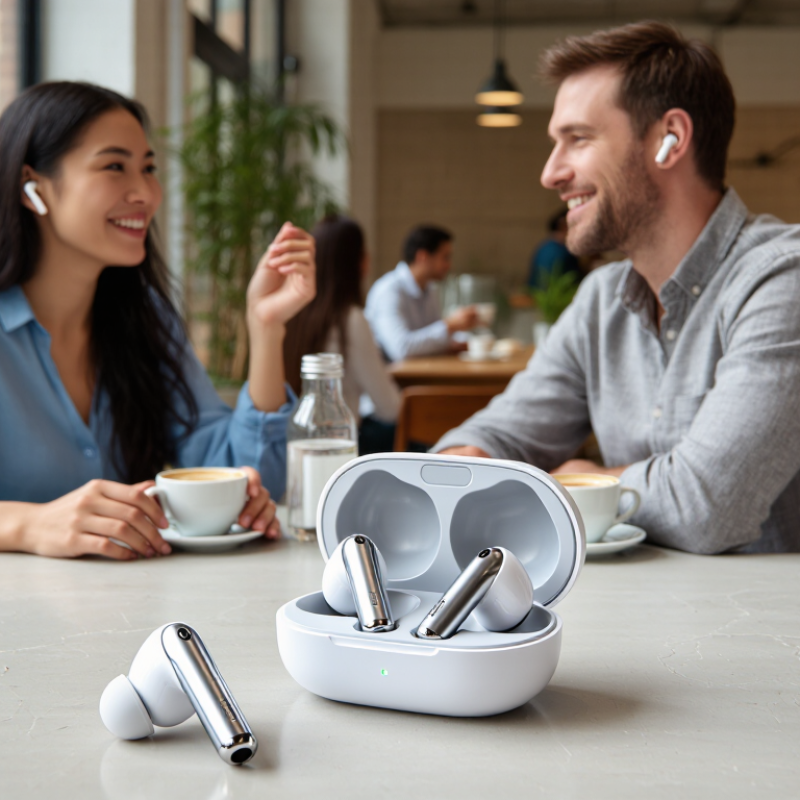
AI translation earbuds are wearable audio devices that help two people communicate across languages. A microphone captures speech, then speech-recognition software converts it into text or language data. Machine translation processes the meaning, and a voice engine plays the result through an earbud or phone speaker. The sequence sounds simple. It isn’t instant.
Many systems rely on a companion app and an internet connection; some process selected languages on the device. Performance depends on microphone quality, background noise, network speed, and language support. In a busy station, a rolling suitcase or loud announcement can obscure a short phrase. CSA Research’s 2020 survey of 8,709 consumers in 29 countries found that 76% preferred product information in their own language. That is not a direct test of earbuds, but it shows why usable multilingual communication matters. Even good software can miss humor, accents, or an unclear sentence. The first translation may sound stiff.
Tips: Test the earbuds with ordinary phrases before traveling, then try them somewhere noisy. Check which languages work offline and whether both speakers need an earbud. Speak in short sentences, pause between thoughts, and confirm important details aloud. A little awkwardness is normal.
When comparing translation earbuds, check supported languages and dialects, not just the total listed. A language may work well in quiet speech but struggle with regional accents or fast conversation. Test the exact language pair you expect to use. If possible, try a short exchange in a café, where dishes clatter and people speak over one another. That reveals more than a polished product demo.
Translation speed matters, but accuracy matters more. A brief pause is usually manageable; a missing negation can change the meaning. Look for clear turn-taking controls, adjustable volume, and a microphone system designed to reduce background noise. Check whether translation requires a phone, a stable internet connection, or a paid service. Offline support can help during travel, though it may cover fewer languages. Read the privacy details too, especially how voice recordings are processed and stored. Small details count.
Comfort and battery life deserve a real-world check. Earbuds that feel fine for ten minutes may become irritating during a long station transfer. Compare the quoted battery life with use during active translation, since continuous listening can drain power faster. Also check charging time, phone compatibility, and replacement or repair support. One overlooked issue: a companion app may be essential, so confirm it works on your device before buying. No model handles every accent or noisy room perfectly; that limitation is easy to underestimate.
Seven AI translation earbuds for global buyers are best compared by how they handle real conversations, not by language-count claims alone. Some prioritize offline language packs for travel with weak internet. Others use cloud processing, which may improve results but depends on a stable connection. Dual-ear designs can support turn-taking between two speakers, while single-ear models leave one ear open to nearby sounds. Small details matter.
A fifth option emphasizes open-ear comfort for long walks or busy stations. A sixth focuses on microphones and noise reduction, useful near traffic or crowded cafés. A seventh pairs translation with extended battery life and a compact charging case. These are feature profiles, not a ranking: the right fit depends on your route, conversation style, and tolerance for wearing earbuds all day.
Before buying, check whether your key languages work offline and whether speech plays aloud or appears in an app. In practice, short, clearly spoken sentences are easier to translate than overlapping speech, slang, or jokes. Translation can lag, and accents may change the result. Not perfectly, though. Test the return policy and comfort if possible; a technically capable earbud is little help when its fit hurts after an hour.
Choosing translation earbuds starts with your actual language route, not the number of languages on the box. Check that both languages are supported in your direction of travel, including the speaking and listening modes you need. A traveler moving between Tokyo stations may value quick, clear exchanges more than dozens of rarely used languages. Ask whether translation works offline, how long the battery lasts, and whether the microphones handle street noise. No specification sheet can promise perfect results with every accent. That limitation matters.
CSA Research’s 2020 survey of 8,709 consumers across 29 countries found that 76% preferred product information in their own language. This is not a travel-earbud test, but it shows why language access can shape decisions. Match the device to your trip: frequent border crossings call for broad language coverage; long rail journeys make battery life and offline access more important. Try a short conversation before relying on the earbuds for detailed directions or bookings. Awkward pauses happen.
Tips: Test your two most-used language pairs in a quiet room and beside traffic. Check the fit after an hour, not just in the store. If the translation sounds uncertain, slow down, repeat the sentence, and confirm key details on screen.
Native-speaker totals offer one useful starting point when prioritizing languages for travel. They are not a measure of earbud translation accuracy or total second-language speakers.
Approximate native speakers, in millions. Source: Ethnologue, 27th edition (2024). Before buying, verify each earbud’s supported languages, dialects, and offline translation options.
Translation earbuds depend on more than microphone quality. Check whether they need a phone app, an internet connection, or both. A café with weak Wi-Fi can turn a quick exchange into a long pause. Some models process basic phrases offline, but downloaded language packs may cover fewer features. Test the exact languages and direction of translation before traveling.
Connectivity affects comfort, too. Bluetooth dropouts can interrupt speech when a phone sits in a bag or across a crowded table. Look for clear reconnection steps and a battery estimate that includes translation use. A quoted playback time may not reflect frequent microphone and network activity. Small detail, big difference.
Privacy deserves equal attention. Review what audio or transcripts the companion app stores, how long it keeps them, and whether deletion controls are easy to find. Avoid sharing sensitive details through a service whose data handling you cannot verify. Translation also has limits: accents, background noise, slang, and overlapping voices can change meaning. “Meet at the east gate” might become something less useful. That is not a rare concern. Use earbuds for everyday conversation, then confirm names, numbers, and important arrangements in plain language. A little awkward, perhaps, but safer.
The entries below are buying profiles, not specific products or independently tested rankings. Features vary by model, app, language pair, and software version; check the product’s current specifications before buying.
| No. | Buyer Profile | Connectivity to Check | Offline Translation | Privacy Considerations | Likely Limitations | Best Suited For |
|---|---|---|---|---|---|---|
| 1 | Phone-connected, cloud-assisted | Usually pairs with a phone over Bluetooth; translation may need the phone’s internet connection. | Often limited or unavailable unless the app explicitly offers downloadable language packs. | Check whether voice recordings or transcripts are sent to online services, retained, or used to improve services. | Weak or unavailable internet can delay or interrupt translation; results depend on the app and language pair. | Travelers who usually have mobile data or Wi-Fi and want app-based features. |
| 2 | Offline-pack focused | Typically requires initial setup and downloads through a compatible phone; confirm whether Bluetooth is required during use. | Can work without a live connection for supported languages if packs are downloaded in advance. | Offline processing may reduce the need to send speech to a server, but verify what the app stores locally and syncs later. | Offline language coverage and quality may be narrower than online coverage; updates may require internet access. | Trips with unreliable data access, after checking supported offline languages. |
| 3 | Two-person conversation mode | May use one or two earbuds, a phone screen, or speaker playback; confirm how the other speaker participates. | Depends on the translation app and its language-pack support. | Both people may be recorded or processed; ask for consent and check recording and deletion controls. | Turn-taking, background noise, and overlapping speech can reduce recognition accuracy or slow the exchange. | Face-to-face travel conversations where speakers can take turns clearly. |
| 4 | Phone-screen assisted | Relies on a compatible phone and app; the screen may show transcripts, language choices, or translated text. | Varies by app; verify offline support separately for each language pair. | Visible transcripts can expose sensitive conversation to nearby people or anyone with access to the phone. | Requires attention to the screen and may be less convenient when walking or speaking in a group. | Users who benefit from reading translations as well as hearing them. |
| 5 | Open-fit, awareness-first | Translation connectivity generally depends on the paired phone and app rather than the earbud fit style. | Check the companion app; open-fit design does not itself provide offline translation. | As with other app-connected options, review microphone permissions, data handling, and recording controls. | Open-fit earbuds may let in more ambient sound, which can make speech recognition harder in noisy places. | People who prefer to remain aware of nearby sounds while using audio assistance. |
| 6 | Noise-isolating, quiet-setting focused | Check phone compatibility, Bluetooth stability, and whether translation runs through a separate app. | Not determined by noise isolation; confirm offline language support independently. | Noise control does not guarantee private processing; check whether speech is handled locally or sent online. | A sealed fit may reduce awareness of surroundings; microphone performance and translation accuracy still vary. | Quiet conversations and users who prioritize reducing ambient listening distractions. |
| 7 | Long-trip, endurance-focused | Check real-world earbud and case battery claims, phone dependence, and whether translation features consume extra power. | Offline support can reduce reliance on a network, but does not remove battery limits or guarantee continuous use. | Review account requirements, cloud processing, saved conversation history, and options to delete stored data. | Battery life varies with volume, call or translation use, connection quality, and settings; published figures may use different test conditions. | Frequent travelers who compare tested battery performance and carry a charging case or backup power. |
Before purchase, confirm the exact language pairs, supported phone operating systems, offline availability, recording policy, and return terms. Machine translation can miss idioms, accents, names, and context; do not rely on it alone for medical, legal, safety-critical, or other high-stakes communication.
A microphone captures speech, and recognition software turns it into text or language data. Translation software processes the meaning, then a voice engine plays the result. It may take a moment.
Many rely on a companion app and internet access. Some support selected offline languages, so check your key language pair before traveling.
Background noise can hide words. A station announcement or rolling suitcase may disrupt a short phrase. Step somewhere quieter when possible.
Use short sentences and pause between thoughts. Avoid talking over the other person. It feels a little unnatural.
It depends on the design. Some support turn-taking between two speakers, while others play translated speech through an earbud or phone speaker.
No. Accents, humor, slang, and unclear sentences can change the result. The first translation may sound stiff.
Check offline language support, microphone performance, battery life, and comfort. A compact charging case helps on the go, but fit matters too.
Repeat the detail aloud and check that both people understand it. Even useful translation can miss a small point. A bit awkward, yes.
AI Translation Earbuds use microphones, speakers, and translation software to help people communicate across language barriers. Depending on the model, they may translate speech in near real time, work with a companion app, or support different listening modes for conversations and travel. When comparing options, consider the languages and dialects supported, translation speed and accuracy, comfort, battery life, ease of use, and whether key features require an internet connection or subscription.
The seven options in this guide offer different combinations of features for global buyers, so the best choice depends on where and how you plan to use them. Match the earbuds to your usual languages, travel habits, and need for offline access. Also review their connectivity requirements and privacy settings, and remember that translations may be delayed or imperfect, especially in noisy places or during complex conversations. AI Translation Earbuds can make cross-language exchanges easier, but they work best as a helpful aid rather than a substitute for clear communication.